Intellectual Property · Design Theory
Quantum IP
La'a Ching · Abel Paul George · 2025 · 18 Min Read
Abstract
Intellectual property law was built for a world of fixed objects and singular authors. Culture no longer works that way. Quantum IP proposes a mathematically grounded framework drawing on graph theory, algebraic topology, and cultural systems thinking, that reimagines ownership for modular, remixable, co-authored creative ecosystems. Rather than treating works as bounded outputs, it views them as living nodes in a network, where fragmentation, entanglement, and nonlinearity replace the static logic of classical IP.
I. Introduction
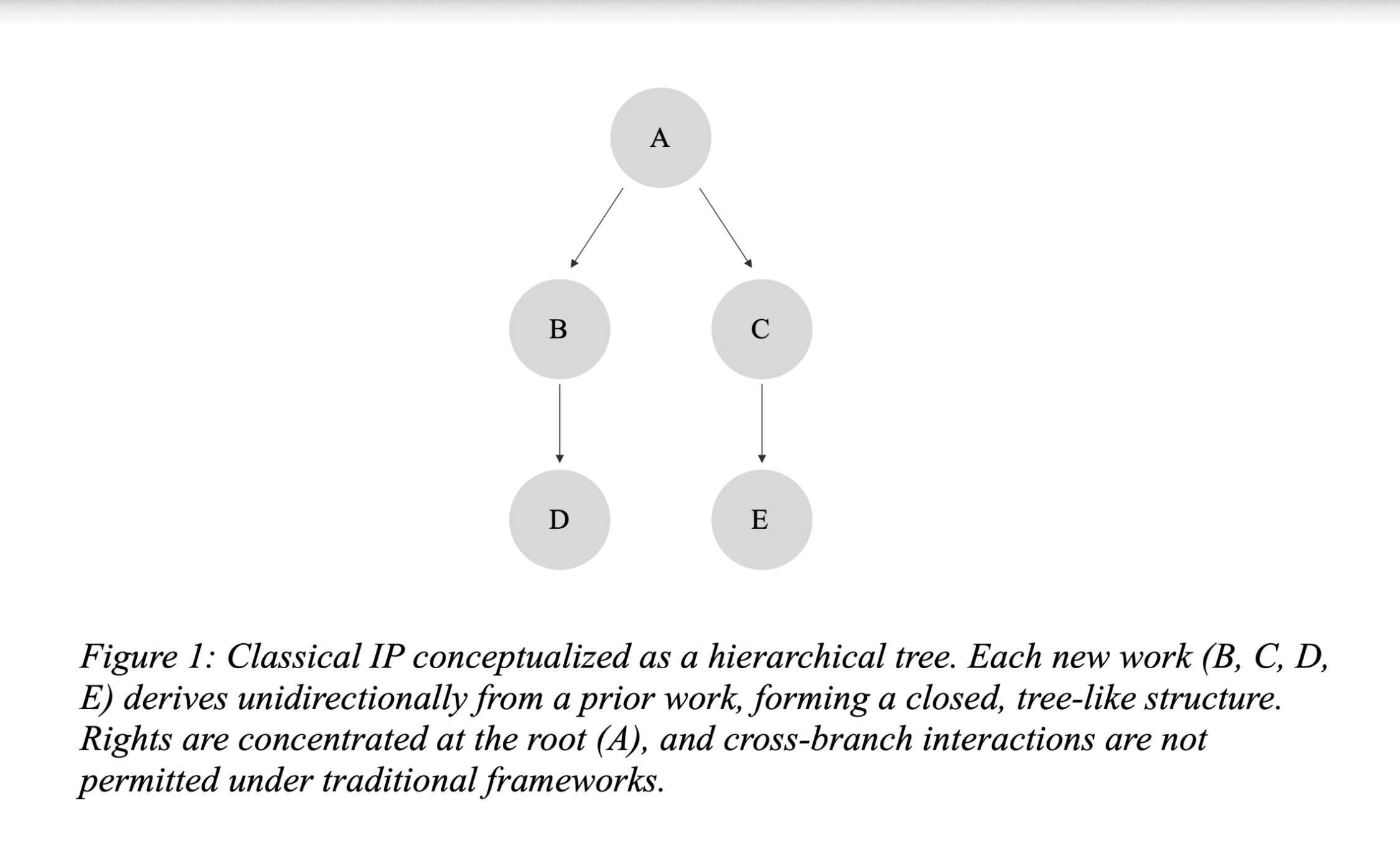
The frameworks we use to protect creative work were built for a different era. Intellectual property law, including copyright, trademark, and patent, emerged from a worldview in which creative works are discrete, bounded objects: a song, a painting, a logo. You make it. You own it. You can sell or license it. Someone else who uses it without permission has taken something from you.
This logic made sense when creativity was largely linear and analog. But we now live in a world where creative works are generated, remixed, trained upon, and distributed at a scale and speed that defies the old containers. An AI model trained on a corpus of human creative work produces outputs that are derivative of thousands of sources simultaneously. A designer's visual language shapes a brand, which influences a generation of students, who remix it into something new. A musician's unreleased demo is reconstructed from fan recordings and redistributed before it officially exists.
The boundaries are not just blurred - they are structurally insufficient.
II. Classical IP: Fixed Roots in a Modular World
The word “intellectual property” is itself a category error. Property implies a fixed thing in a fixed place. Intellectual work is neither fixed nor bounded. A melody is an arrangement of vibrations; a design is a set of relationships between elements; a brand identity is a pattern of associations built in the minds of a public.
IP law attempts to freeze these fluid things into legal objects. The moment of fixation, when a song is recorded or a design is registered, creates the artifact that law can point to. But the creative work itself began long before fixation, and continues long after, evolving through performance, interpretation, influence, and reference.
Classical IP is built on three foundational assumptions: that creative works have identifiable authors, that those works can be bounded and separated from their influences, and that control over reproduction is the correct mechanism for protecting creative investment. Each of these assumptions is under significant strain in the contemporary creative environment.
III. Digital Cracks and the Rise of Narrative Networks
The digital turn did not create the tension between creativity and IP - it revealed and accelerated it. Sampling, remixing, open-source software, creative commons licensing, fan fiction, and meme culture all represent creative communities developing their own norms around attribution and use that operate parallel to, and often in conflict with, formal IP law.
What these communities share is an understanding that creative value is generated through network effects, not through isolation.
“The real value lies in how content travels, mutates, and builds communal meaning.”
Platforms like YouTube, SoundCloud, and TikTok have created new forms of collaborative creativity that are fundamentally incompatible with classical IP assumptions. A song goes viral through millions of transformative uses. A visual format spreads through infinite variations. Attribution becomes distributed and often unverifiable. The network creates value that no single node could claim.
The quantum analogy is instructive. Before a work is published or registered, it exists as potential: a sketch might become a logo, a voice memo might become a hit, a typeface draft might become a canonical design language. The moment of “fixation,” like the moment of measurement in quantum mechanics, collapses that potential into a legal object. But unlike a particle, creative works don't stay collapsed. They continue to evolve in the minds of audiences, in the hands of other creators, in the archives of training sets.
IV. Mathematical and Network Foundations of Modern Creativity
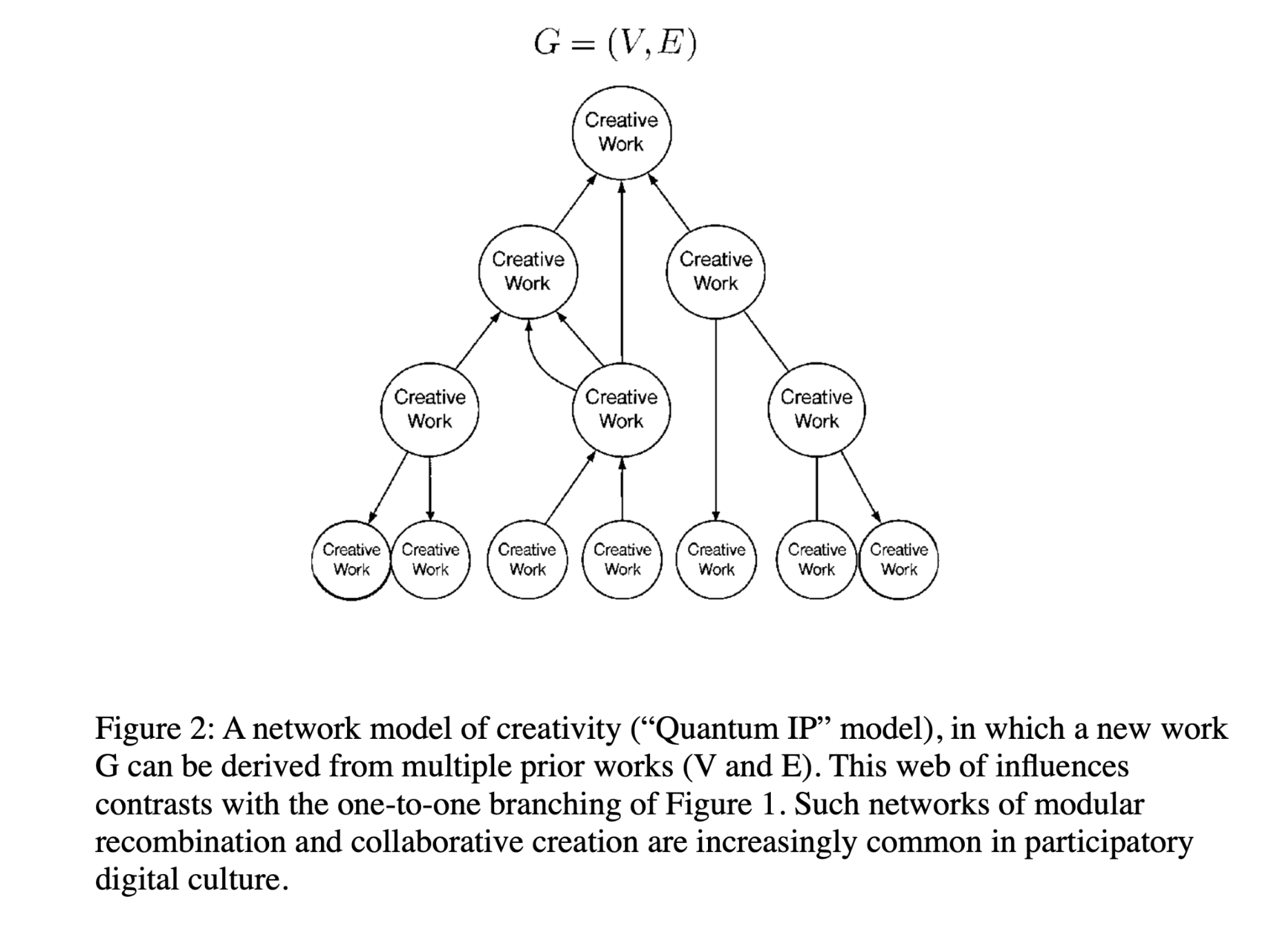
Quantum IP draws on graph theory, algebraic topology, and cultural systems thinking to model creative relationships with precision. Rather than treating creative works as bounded outputs, it views them as living nodes in a network where the edges, the relationships of influence, derivation, and collaboration, carry as much information as the nodes themselves.
“Rather than treating creative works as singular, bounded objects, Quantum IP views them as nodes in a living network.”
Graph theory provides tools for modeling the structure of creative networks: identifying hubs of influence, measuring the shortest path between creative traditions, detecting communities of practice. Algebraic topology extends this to capture higher-dimensional relationships - not just pairwise connections between works, but the complex structures formed when multiple works co-evolve.
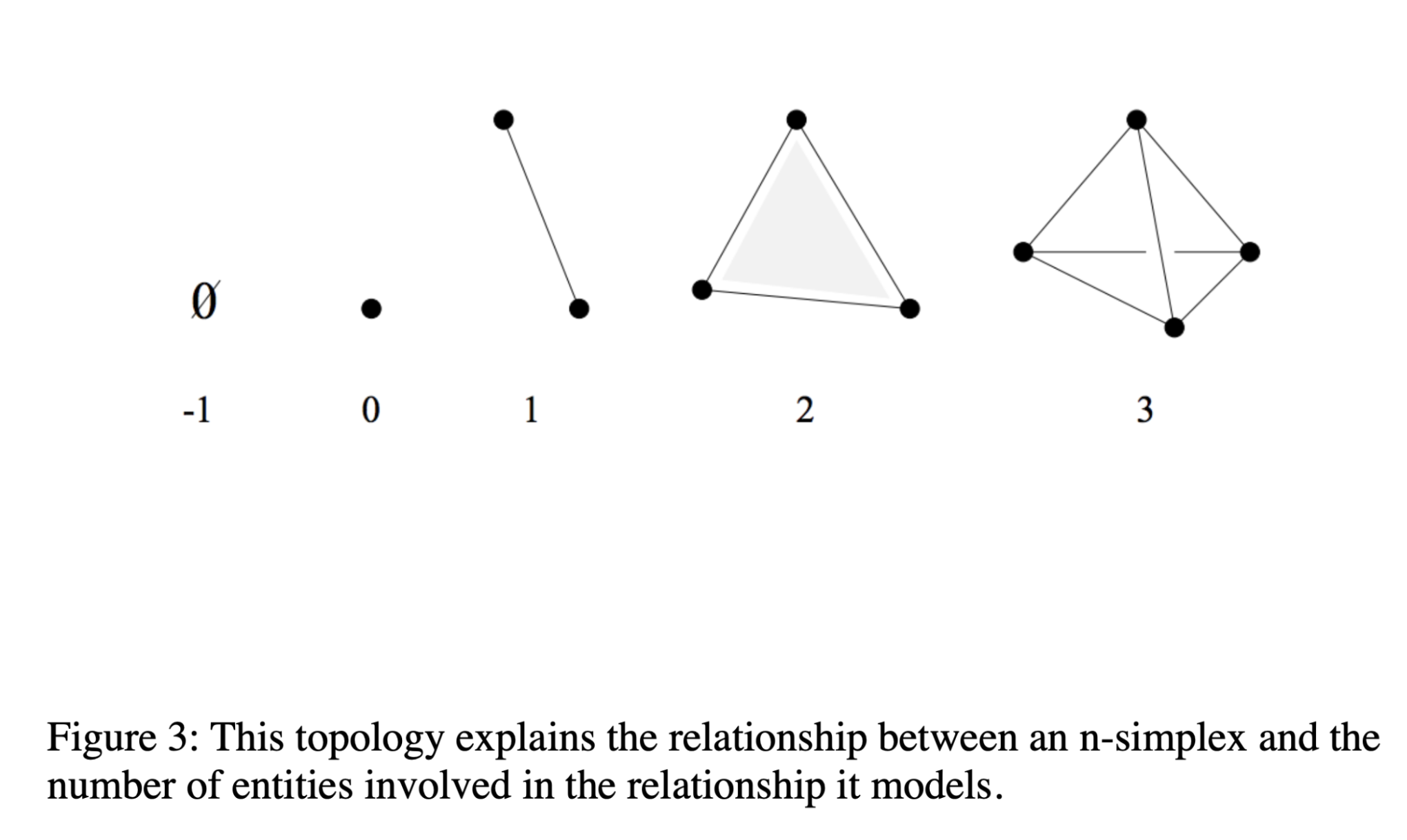
The simplex, the generalization of triangles and tetrahedra to higher dimensions, provides a precise vocabulary for describing multi-party creative relationships. A 1-simplex is a direct collaboration or derivation between two nodes. A 2-simplex is a triangle: three parties in mutual relationship. As the number of co-contributing parties grows, the dimension of the simplex grows accordingly, capturing the full structure of collaborative creative ecosystems.
V. Quantum IP: Principles for a Living Rights System
Quantum IP rests on a fundamental reorientation: from protection of objects to recognition of relationships. This is not a naïve call to abandon property rights. Independent creators, especially those operating outside major institutional support, need protection from exploitation. But the existing model of protection is built around confrontation: you own something, and others must be kept away from it. A networked model thinks differently.
Protection comes not from exclusion but from attribution, from traceability, from the ability to demonstrate contribution to a living creative lineage.
Core Principles
Traceability over exclusivity. Creative lineage should be documentable and verifiable. The goal is not to prevent others from building on a work, but to ensure that the chain of contribution is legible.
Contribution over fixation. Legal recognition should attach to creative contribution, not only to the fixed artifact. The songwriter whose chord progression shapes a generation of music should have tools to document and assert that contribution, even when the direct copyright is diffuse.
Community stewardship. Where creative work is rooted in community cultural knowledge, the community should have legal standing to assert stewardship rights, meaning obligations on those who derive from that knowledge to engage with, compensate, and not misrepresent the source.
VI. In Practice: Modeling Participatory Systems
The stakes of this rethinking are highest for creators whose work is deeply embedded in cultural identity, where the creative work is not separable from the community that produced it.
Consider a designer whose visual language is rooted in Pacific island aesthetics. Under existing IP frameworks, that designer can copyright individual works. But the broader visual vocabulary, shaped by centuries of cultural practice, remains unprotectable. A large corporation can hire that designer, extract the aesthetic logic, and apply it globally with no obligation to the community that developed it.
Quantum IP suggests a framework in which cultural contribution is legible. The designer's work is traceable to its sources. The corporation's application of that aesthetic creates a documented relationship of derivation that can be the basis of fair compensation, recognition, and stewardship obligations, not just exclusion.
In participatory systems like open-source development, collaborative world-building, and community artistic traditions, the network model maps naturally onto existing practice. Contributors already understand their work as part of a larger whole. What is missing is the legal infrastructure to recognize and formalize that understanding.
VII. Implementation: Toward a Network-Native Creative Rights Infrastructure
Translating Quantum IP from conceptual framework to practical implementation requires new legal instruments, new technical infrastructure, and new institutional arrangements. None of these needs to be invented from scratch - existing tools can be extended and combined to support a network-native rights system.
Implementation Pathways
Distributed ledger systems for immutable creative provenance tracking
Graph database infrastructure for mapping creative lineage at scale
Attribution protocols that travel with creative works across platforms
Collective licensing bodies with expanded mandates for cultural stewardship
Legal frameworks recognizing community IP alongside individual IP
The independent creators operating at the intersection of culture and commerce need legal tools that match the reality of their work. The existing framework asks them to choose between protection and participation. A network-native infrastructure removes that false choice.
VIII. Conclusion: From Ownership to Stewardship
We are not arguing that intellectual property is obsolete. We are arguing that the metaphor of property, discrete, bounded, and owned, is increasingly inadequate to describe how creative work actually moves through the world.
Quantum IP is an invitation to think differently about what we're protecting and why. Not the object, but the network. Not the fixation, but the contribution. Not the fence, but the trace.
“The future of cultural production will not belong to those who hold on the tightest, but to those who build the most fertile environments for creativity to flow.”
The shift from ownership to stewardship is not a loss. It is a recognition that the value of creative work is generated through its movement through the world, through its influence on other work, through its accumulation of meaning across contexts and communities. A stewardship model protects that value while enabling the circulation that generates it.
References
[1] Deloitte. Fan Loyalty and the Future of Entertainment. Digital Media Trends 2024, Deloitte Insights.
[2] H. Jenkins, Confronting the Challenges of Participatory Culture: Media Education for the 21st Century. MacArthur Foundation, 2006.
[3] W. M. Landes and R. A. Posner, The Economic Structure of Intellectual Property Law. Cambridge, MA: Harvard Univ. Press, 2003.
[4] L. Lessig, Remix: Making Art and Commerce Thrive in the Hybrid Economy. New York, NY: Penguin Press, 2008.
[5] M. Rose, Authors and Owners: The Invention of Copyright. Cambridge, MA: Harvard Univ. Press, 1993.
[6] M. Chaduneli, "The future of intellectual property in the era of AI," Network Readiness Index, 2023.
[7] G. Deleuze and F. Guattari, A Thousand Plateaus: Capitalism and Schizophrenia. Minneapolis, MN: Univ. of Minnesota Press, 1987.
[8] F. Alfieri et al., "Creative influence prediction using graph theory," in Proc. CREAI Workshop, 2023.
[9] C. Y. Baldwin and J. Henkel, "Modularity and intellectual property protection," Strategic Management Journal, vol. 35, no. 11, pp. 1789-1817, 2014.
[10] T. Gebhart, "Measuring breakthrough discovery and invention with algebraic topology," arXiv preprint arXiv:2103.10216, 2021.
[11] Epic Games, "Fortnite Creator Economy 2.0 overview," Epic Games Developer Blog, 2023.
[12] Futurism, "OpenAI restricts Ghibli-style generations following backlash," Futurism, 2025.
[13] S. Persson, "GDC talk on the future of UGC in Fortnite," Game Developers Conference, 2024.
[14] The Vault, "The cultural logic of doujinshi," The Vault Magazine, 2023.
[15] The Week, "Why Studio Ghibli fans hate AI art filters," The Week, 2025.
[16] Q. Van Tran, "Legal gray zones and the doujinshi economy," Journal of Japanese Studies, vol. 46, no. 2, pp. 345-369, 2020.
[17] J. Cohen, Configuring the Networked Self: Law, Code, and the Play of Everyday Practice. Yale University Press, 2012.
[18] MarketsandMarkets, "User Generated Content (UGC) Platform Market by Component, Content Type, Deployment Mode, Organization Size, Vertical, and Region - Global Forecast to 2028," 2023.
[19] B. Frischmann, Infrastructure: The Social Value of Shared Resources. Oxford University Press, 2012.